
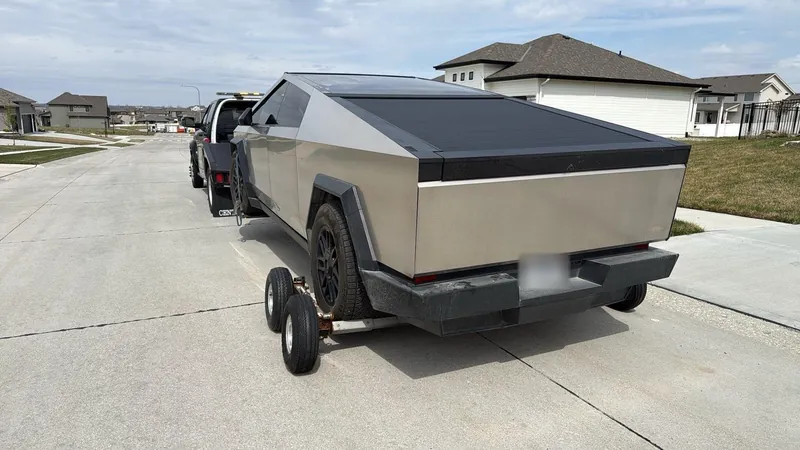
Why EVs shouldn't be towed with wheels down
In most electric vehicles the drive motor is connected to the wheels whenever they turn. Towing with drive wheels on the road can spin the motor and generate current the car isn't expecting, which can damage the drive system. That's why EV owner's manuals generally say not to tow with the drive wheels on the road. Many hybrids have the same warning. Dollies or a flatbed keep the wheels off the pavement.
How we tow an electric vehicle
- Put it in transport or tow modeMany EVs (Tesla's Transport Mode, for example) have a setting that lets the wheels roll freely so the car can be winched. We'll walk you through it if the screen still works.
- Lift it with the wheels off the groundOn a wheel-lift with dollies or a flatbed, using the manufacturer's tow eye or approved points, never the battery pack.
- Strap the wheels, not the bodyWheel straps keep the car's underbody and battery pack clear.
- Deliver where you chooseService center, dealer, body shop or home charger.
EVs and hybrids we tow
- Tesla: Model 3, Model Y, Model S, Model X, Cybertruck
- Rivian R1T and R1S
- Ford Mustang Mach-E and F-150 Lightning
- Chevrolet Bolt, Equinox EV, Silverado EV, and GMC Hummer EV
- Hyundai Ioniq 5 and Ioniq 6, Kia EV6 and EV9
- Nissan Leaf and Ariya, VW ID.4, BMW i4 and iX
- Hybrids and plug-in hybrids: Prius, RAV4 Hybrid and more
Dead battery? You may not need a tow
An EV that shows zero range might still need nothing more than a trip to a charger, and some 12-volt battery problems can be handled on site. Tell us what the dash is showing. If it's the small 12-volt battery, a jump start may get it back on the road.
EVs after an accident
Collision-damaged EVs are handled with extra caution around the battery. Let us know about any warnings on the screen, smells or smoke, and call 911 first if you see smoke.